


You can bolt AI onto your Asterisk system today… and spend the next six months debugging jitter, slow responses, and broken call flows. Or you can prepare the system properly and avoid burning time and money later.
The choice is completely yours, but here’s why rushing into AI is the fastest way to choke your communication setup. Most Asterisk deployments were never designed to handle real-time AI workloads. And once you mix traditional IVRs with LLMs or voicebots, all the hidden bottlenecks you’ve ignored for years start showing up immediately.
The truth is, many teams walk into AI with the wrong assumptions. They think, “We can just plug in Dialogflow, and it will work, right?”
But that’s not how AI-driven telephony behaves. Your architecture, your dialplan, your audio routing, all of it needs a rethink if you want AI to sound natural instead of confused and slow. And if you’d rather build it right from the start, the right Asterisk development approach can turn your system into something that actually supports real-time automation instead of struggling under it.
That’s why the smarter move is to prepare your Asterisk setup first. Once the foundation is ready, AI doesn’t struggle; it performs. Here’s the path to get there.
Preparing Your Asterisk Deployment for AI and Voice Automation
Before you integrate Dialogflow, Azure Cognitive Services, or any custom voice automation engine, your Asterisk setup must align with how AI operates in real time. Under this section, we’ll break down each step you need to follow, from a complete asterisk telephony upgrade and dialplan redesign to choosing the right AI stack, planning for capacity, designing fallbacks, and building compliance into every interaction.
Think of it as a structured roadmap that ensures your AI integration doesn’t just “connect,” but performs reliably under everyday business workloads.
Step 1: Modernize Your Core Asterisk Architecture
Before you bring any Asterisk AI capabilities into your system, you have to make sure the foundation isn’t holding you back. AI needs fast audio flow, low latency, and the ability to process real-time responses, none of which work well on an outdated server or a dialplan designed ten years ago. So start by checking the basics: CPU load, memory headroom, network stability, and how cleanly your system handles STT and TTS media streams.
Think of this step as the backbone of your Asterisk AI architecture. If your system struggles with transcoding or spikes CPU usage on busy hours, an AI engine will only amplify those issues. Once you clean up the fundamentals, optimize codecs, fix jitter problems, update modules, modernize configurations, you’re giving your future voice automation the breathing room it needs to actually perform well.
Step 2: Redesign Your Dialplan for AI-Driven Call Flows
AI isn’t built for rigid menus like “Press 1 for Billing.” If you drop an asterisk voice bot into that environment, the experience will feel slow, unnatural, and downright frustrating. AI thrives when callers can speak naturally, and the system can understand intents instead of button inputs.
That means your dialplan needs a structural shift. You’re moving from step-by-step navigation to dynamic, intent-based routing. The dialplan should be ready to:
- Receive speech input continuously
- Handle low-confidence responses gracefully
- Interrupt or redirect conversations based on context
- Trigger real-time API calls
- Pass caller context back into Asterisk seamlessly
This step is about making sure your dialplan isn’t fighting your AI, it’s enabling it. Without this redesign, your Asterisk AI deployment will always feel like a force-fit.
Step 3: Choose the Right AI Engine and Integration Approach
Now comes the decision everyone tries to jump to prematurely: Which AI should I use? Dialogflow, Azure Cognitive Services, Amazon Lex, custom LLMs. They all work, but only some will actually perform well in your environment.
For low-latency, natural speech automation, Dialogflow CX and Azure are strong options. For industry-specific use cases or custom vocabulary, a fine-tuned model may work better. But what matters more than brand names is how you integrate them into Asterisk.
Your options include:
- SIP-based bridging for simplicity
- REST APIs for call control
- ARI for advanced AI-based call routing and voice analysis
- gRPC for real-time streaming
- Hybrid setups for complex automation
The right choice depends on how fast you need responses and how many interactions happen per second. This decision directly affects the stability of your Asterisk AI architecture under peak load.
Step 4: Plan for Capacity, Concurrency, and Real-Time Load
Everyone loves the idea of automation… until they test it with real traffic and watch the system choke. Handling one AI-driven call is easy. Handling fifty at once is where things get real.
Each AI-powered call triggers:
- STT (speech-to-text) for every spoken word
- NLU (intent detection) in real time
- TTS (text-to-speech) responses
- API calls during the interaction
All of this stacks up. So you need to know your concurrency limits upfront. That includes checking:
- How many AI requests can your server handle per second
- Whether your network can support real-time streaming
- How fast does your AI engine respond under load
- Whether you need separate nodes for STT, TTS, and NLU
A scalable Asterisk AI deployment always plans for tomorrow’s call volume, not today’s.
Step 5: Build Reliable Fallbacks and Failure Handling
No matter how advanced your Asterisk AI setup is, AI engines will fail occasionally, experience timeouts, low confidence, slow responses, or even full service outages. If you don’t design fallbacks, your customers will feel every one of those failures.
Your system needs to be ready to:
- Switch from AI to DTMF instantly
- Transfer callers to agents when AI confidence drops
- Handle silence or unclear speech gracefully
- Retry or re-route requests when APIs slow down
- Failover between primary and secondary AI engines
A smart fallback design keeps your AI invisible during failures; the caller shouldn’t know anything failed. That’s what separates a polished automation experience from a messy one.
Step 6: Address Compliance, Data Security, and User Privacy
Here’s where most businesses underestimate the complexity: the compliance considerations when using AI in telephony aren’t optional. AI doesn’t just process audio; it stores transcripts, logs intents, handles personal data, and sometimes even payment information. That means your setup must comply with:
- PCI-DSS if you handle card details
- HIPAA if you deal with health-related data
- GDPR for EU callers
- Local call-recording laws
- Data retention and deletion mandates
On the technical side, you also need to secure ARI, AMI, API keys, transcription logs, and internal endpoints. Encryption, access control, and secure token usage aren’t “nice to have”, they’re mandatory if you don’t want your Asterisk AI deployment to become a liability.
Step 7: Test, Benchmark, and Optimize Your AI Call Flows
Once everything is connected, don’t assume it will perform perfectly in production. You need to test how AI performs under real conditions, real accents, real background noise, and real customer impatience.
Benchmark your AI for:
- Latency in responses
- STT accuracy in noisy environments
- How fast are intents recognized
- AI confidence levels under different scenarios
- Call drop or abandonment rates
- Speed of transitions between AI and human agents
This stage is where your automation gets polished. It’s where your asterisk voice bot stops sounding robotic and starts feeling natural, predictable, and genuinely helpful.
Now that you know what your Asterisk AI deployment needs, the next step is turning these requirements into an actual plan. So let’s break it down into a practical migration roadmap you can follow without guesswork.
Practical Migration Roadmap for a Successful Asterisk AI Deployment
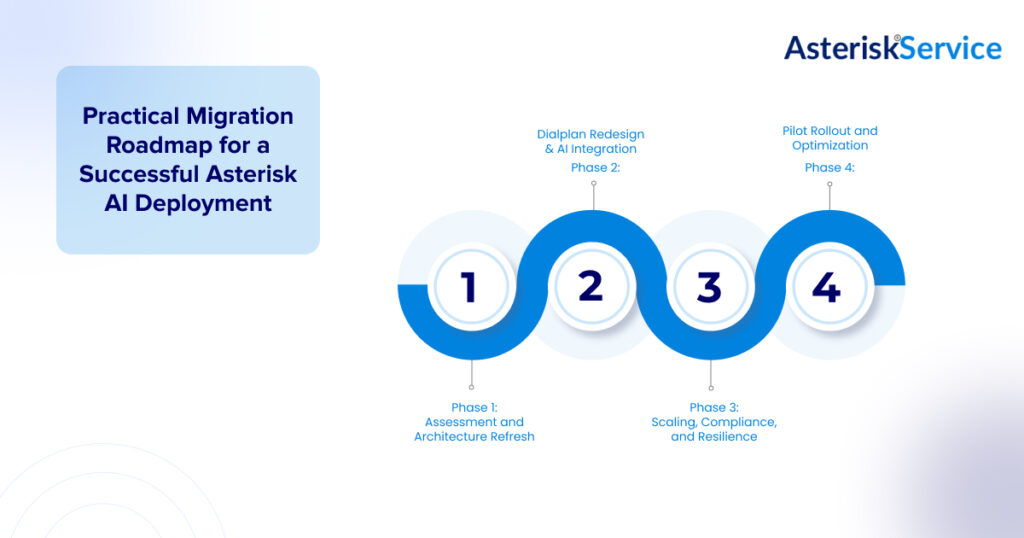
This roadmap breaks your Asterisk AI deployment into clear, manageable phases so you’re not trying to overhaul everything at once. Instead of guessing where to start or what to prioritize, you’ll follow a sequence that stabilizes your current setup, introduces AI gradually, and ensures every change is tested before moving to the next step. From architecture upgrades to dialplan redesigns and final rollout, this roadmap gives you a structured path to integrate AI without disrupting your existing communication workflows.
Phase 1: Assessment & Architecture Refresh
Start by taking an honest look at where your Asterisk system stands today. What can it handle comfortably, and where does it struggle? This is where you check server load, audio paths, latency pockets, and overall readiness for real-time AI. And once you spot the weak links, you refresh the architectur,e so AI has a clean, reliable foundation to run on.
Phase 2: Dialplan Redesign & AI Integration
After the base is solid, it’s time to rethink how callers move through your system. Because a traditional IVR won’t get you far once you move to a dynamic IVR solution. You’ll redesign your dialplan so it supports intent-based routing, natural speech, and smooth handoffs between Asterisk and your AI engine. This is also where your asterisk voice bot starts taking shape and actually becomes part of the conversation flow.
Phase 3: Scaling, Compliance, and Resilience
Now that AI is in the loop, you need to make sure it can scale and stay compliant. So this phase focuses on understanding how many AI-driven calls your setup can handle at once and what you need to upgrade to keep things fast under load. And because you’re dealing with sensitive data, this is also where you tackle the compliance considerations when using AI in telephony. Plus, you’ll build in resilience so your Asterisk AI architecture keeps running even if an AI service slows down or temporarily fails.
Phase 4: Pilot Rollout and Optimization
Finally, you test everything in the real world. Instead of flipping the switch for everyone, you run a pilot with a controlled group of calls and see how the system behaves when real people interact with it. And as you notice where the AI hesitates, misunderstands, or takes a bit too long, you tune things until the experience feels smooth. Once the pilot performs consistently, you’re ready to scale it across your full Asterisk AI deployment.
Now that your Asterisk AI deployment is technically ready to scale, it’s just as important to make sure it’s legally and operationally compliant.
What are the Compliance Considerations When Using AI in Telephony
AI doesn’t just change how your calls are handled, it also changes how your data is collected, processed, stored, and protected. The moment you introduce voice automation, speech-to-text, and intent analysis into live calls, you step into a much heavier compliance zone. Under this section, we’ll break down the compliance considerations when using AI in telephony, from call recording laws and transcript storage to data privacy, security controls, and industry-specific regulations, so you can automate confidently without putting your business at legal risk.
- Call recording consent:
Always inform callers that their calls may be recorded and processed by AI. In many regions, explicit consent is mandatory before recording or analyzing voice data. - Data storage and retention policies:
AI systems store audio, transcripts, and intent data. You need clear rules on where this data is stored, how long it’s kept, and when it’s permanently deleted. - Sensitive data protection (PCI, HIPAA, PII):
If your calls include payments, medical information, or personal identifiers, your AI flows must support masking, pausing recordings, or secure handling of this data. - AI transcript and intent log security:
Transcripts reveal customer behavior and business insights. These must be encrypted, tightly access-controlled, and fully audited to prevent internal misuse or leaks. - Third-party AI provider compliance:
If you’re using cloud-based STT, NLU, or TTS services, you’re still responsible for how customer data is handled. You must verify their data usage, storage policies, and training practices. - Cross-border data transfer regulations:
When caller data moves across countries, regional data residency and transfer laws apply. This is critical for global Asterisk AI deployments. - Access controls for AI systems:
Only authorized teams should be able to view AI transcripts, intent reports, and call analytics. Role-based access is essential. - Audit trails and compliance reporting:
Your system should log who accessed what data and when, so you can prove compliance during audits or investigations.
In short, the compliance considerations when using AI in telephony come down to three things: protecting customer data, controlling access to sensitive information, and staying aligned with regional and industry regulations. If those pillars are solid, your AI automation stays both powerful and legally safe.
With compliance covered, it’s time to zoom out and bring everything together in the final takeaway.
The Bottom Line
AI can completely change how your Asterisk system handles conversations, but only if you prepare it the right way. Rush it, and you’ll fight delays, broken call flows, and endless fixes. Take the time to build the foundation first, though, and your communication setup starts working smarter, faster, and with far less friction. And once that shift happens, AI doesn’t just support your operations, it quietly upgrades how your whole business communicates.
And if you’d rather not experiment on a live system, getting help from experienced Asterisk services can save you months of rework and help you build it right the first time.