


Summary:
Traditional call routing systems move calls efficiently but miss the intent, sentiment, and context behind every conversation.
This blog explores how Asterisk AI combines speech recognition, language models, and real-time voice analysis to automate routing and improve customer experiences.
Read on to learn the architecture behind an Asterisk AI voice agent, key latency considerations, and the deployment decisions that shape production-ready implementations.
Twelve seconds into a call, a customer sighs. Not a big sigh, just a tired exhale, the kind that says:
I’VE ALREADY EXPLAINED THIS TWICE.
Your agent doesn’t catch it, Your IVR didn’t catch it, Your QA team won’t catch it either, because nobody reviews this call.
It gets logged, closed, and forgotten. Multiply that sigh across 10,000 calls a month, and you have the most expensive customer experience data your business has ever collected, and never read.
AI with Asterisk is what finally lets that data speak because everyone wants smarter communications, but not everyone agrees on how AI should fit into the voice stack.
Today, AI is transforming Asterisk telephony systems far beyond basic call handling. Businesses can use Asterisk AI integration for intelligent call routing, real-time voice analysis, and AI voice agents that understand and respond to customer intent.
This guide explores how AI and Asterisk work together, the architecture behind it, practical use cases, and the best practices for building scalable voice experiences.
Asterisk AI refers to the integration of artificial intelligence – speech recognition, NLU, LLMs, and sentiment analysis with the Asterisk telephony platform to enable intelligent routing and real-time voice analysis.
What Are the Limitations of Traditional Asterisk Call Routing?
Traditional Asterisk call routing systems are no longer enough because they rely on fixed rules, while modern customer interactions require real-time understanding and intelligent decision-making.
Most conventional call flows were designed to move calls from one point to another. They were not built to understand caller intent, urgency, or conversation context.
1. Static IVR Menus Create Friction
Traditional IVRs depend on callers selecting the right option.
- Press 1 for Sales…
- Press 2 for Support…
- Press 3 for Billing…
This approach may handle straightforward requests efficiently, but without the capabilities of a smart IVR, complex customer needs can lead to routing errors and longer wait times.
2. Rule-Based Routing Has Limited Intelligence
Conventional routing follows predefined conditions.
As a result, it offers:
- Limited personalization
- No intent recognition
- No context awareness
Every caller is treated according to rules, not their actual needs.
3. Traditional Systems Lack Conversation Intelligence
A standard Asterisk telephony system can route calls efficiently. However, it cannot understand what is happening during the conversation.
Traditional systems cannot:
- Detect sentiment
- Identify urgency
- Understand customer intent
- Trigger automated actions
This is where Asterisk AI integration changes the equation. By combining AI with Asterisk, businesses can move beyond static routing and create communication experiences that respond intelligently to every caller.
What is Asterisk AI Integration and How Does It Work?
Asterisk AI integration connects artificial intelligence services with the Asterisk telephony system to enable smarter call routing, voice automation, and real-time conversation intelligence.
Asterisk acts as the communication layer, while AI systems analyze, interpret, and respond to voice interactions. The integration is typically achieved through several interfaces and protocols.
How AI Connects with Asterisk
AI applications can interact with Asterisk using:
- AGI (Asterisk Gateway Interface) for executing external scripts during calls
- FastAGI for handling requests on remote servers
- Asterisk ARI (Asterisk REST Interface) for advanced call control and automation
- REST APIs for exchanging data with AI platforms
- WebSockets for real-time communication and event handling
- SIP integrations for connecting AI-powered voice services
These integration methods allow AI engines to access call data and influence call flows in real time.
- Core AI Capabilities Added to Asterisk
- Speech Recognition – Converts spoken conversations into text for further processing.
- Natural Language Understanding (NLU) – Identifies caller intent and extracts meaningful context.
- Large Language Models (LLMs) – Power conversational experiences with more natural interactions.
- Sentiment Analysis – Detects emotions such as frustration, satisfaction, or urgency.
- Voice Biometrics – Verifies caller identity using unique voice characteristics.
- Predictive Decision Engines – Analyze historical data to optimize routing and service outcomes.
Together, these capabilities transform Asterisk from a call-handling platform into an intelligent communication system.
How Does AI Improve Call Routing in Asterisk?
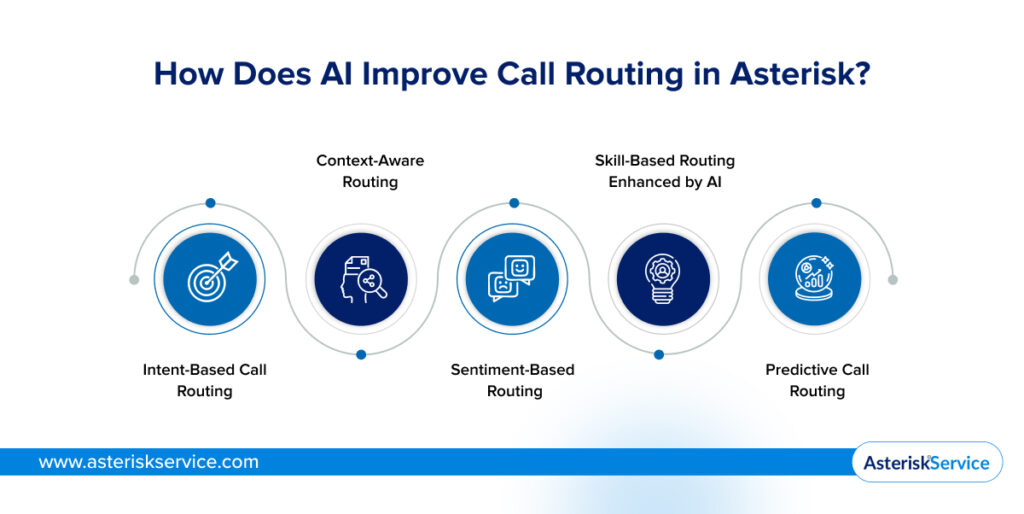
AI improves call routing in Asterisk by analyzing caller intent, context, and real-time conversation data before deciding where a call should go.
Unlike traditional routing, which relies on predefined rules, AI can evaluate what callers say in real time and route them accordingly.
A well-planned Asterisk deployment for AI helps businesses improve response times, streamline call handling, and deliver more personalized interactions.
1. Intent-Based Call Routing
Instead of navigating multiple menu options, callers can simply explain why they are calling.
For example, a caller might say:
“I need help with my invoice.”
AI identifies the billing-related intent and routes the call directly to the appropriate team.
Benefits include:
- Faster issue resolution
- Fewer call transfers
- Improved customer experience
2. Context-Aware Routing
AI can evaluate information from multiple business systems before routing a call.
This may include:
- CRM records
- Customer history
- Previous interactions
- Account status
As a result, routing decisions become more personalized and relevant.
For example, a high-value customer can be automatically directed to a priority support queue.
3. Sentiment-Based Routing
Not every call requires the same level of attention. AI can assess the emotional tone of a conversation in real time.
It can detect:
- Frustration
- Anger
- Urgency
- Satisfaction
Based on these insights, the system can:
- Escalate frustrated callers
- Prioritize urgent requests
- Alert supervisors when needed
4. Skill-Based Routing Enhanced by AI
Traditional skill-based routing relies on static rules and predefined agent groups.
AI takes a more dynamic approach by evaluating:
- Agent expertise
- Historical success rates
- Customer profile
- Conversation context
This increases the likelihood of connecting callers with the right agent on the first attempt.
5. Predictive Call Routing
Predictive routing uses AI models to determine the most suitable destination before a transfer occurs.
The system analyzes:
- Call patterns
- Agent performance
- Customer behavior
This helps optimize routing decisions, reduce wait times, and improve first-call resolution rates.
Together, these capabilities make AI with Asterisk a powerful approach for building intelligent, customer-focused communication experiences.
AI can do more than decide where calls go.
What is an Asterisk AI Agent and How is it Built?
An Asterisk AI agent is an AI-powered voice assistant that integrates with the Asterisk telephony system to handle conversations, automate tasks, and assist callers in real time.
The difference between a standard IVR and a conversational IVR lies in how they interact with callers. While traditional systems depend on menu selections, an Asterisk AI voice agent can understand natural language, access business systems, and respond intelligently to customer requests. It can also handle routine queries and escalate calls when necessary.
What Can an Asterisk AI Agent Do?
A modern Asterisk AI agent can:
- Answer incoming calls
- Understand natural language
- Access business systems
- Execute predefined tasks
- Escalate calls when necessary
This helps businesses automate routine interactions while maintaining a smooth customer experience.
Core Components of an Asterisk AI Voice Agent
Building an effective AI with Asterisk solution requires multiple technologies working together.
- Asterisk PBX – The Asterisk PBX manages call control and handles the flow of incoming and outgoing communications.
- Speech-to-Text Engine – This component converts spoken conversations into text that AI systems can process and understand.
- LLM or Conversational AI Engine – The AI engine interprets requests, understands intent, and generates relevant responses during the conversation.
- Business Logic Layer – The business logic layer applies workflows and determines what actions should be taken based on user input.
- Text-to-Speech Engine – This component converts AI-generated responses into natural-sounding voice interactions.
- CRM and Backend Integrations – Integrations with CRM platforms and business applications provide access to customer records, account information, and operational data.
Together, these components enable Asterisk AI integration to automate conversations and deliver more intelligent, personalized customer interactions.
Calls don’t just need handling. They need understanding.
What is Real-Time Voice Analysis in Asterisk and Why Does It Matter?
Real-time voice analysis in Asterisk uses AI to analyze live conversations and extract actionable insights as calls happen.
Instead of simply connecting calls, Asterisk AI and voice automation integration can help businesses understand customer behavior, measure agent performance, and identify opportunities for improvement.
This turns every conversation into a valuable source of operational intelligence.
1. Real-Time Transcription
Real-time transcription converts voice conversations into searchable text as calls take place.
This makes customer interactions easier to review, analyze, and manage.
Key benefits include:
- Compliance monitoring
- Agent coaching
- Quality assurance
- Faster conversation reviews
2. Sentiment Analysis
Sentiment analysis tracks customer emotions throughout a call.
AI can identify signs of frustration, urgency, satisfaction, or dissatisfaction in real time.
Business outcomes include:
- Reduced customer churn
- Improved customer experiences
- Early identification of escalation risks
3. Call Summarization
AI can automatically generate summaries at the end of each interaction.
This eliminates the need for agents to manually document every conversation.
Benefits include:
- Reduced wrap-up time
- Improved agent productivity
- Better CRM documentation
4. Keyword and Topic Detection
AI can continuously monitor conversations for important words, phrases, and topics.
This helps businesses quickly identify:
- Customer complaints
- Product requests
- Compliance risks
- Competitive mentions
5. Conversational Intelligence
Conversational intelligence goes beyond transcription and analyzes the overall interaction.
It helps uncover patterns that may otherwise go unnoticed.
Examples include:
- Customer intent
- Agent effectiveness
- Common objections
- Resolution trends
When combined with AI and Asterisk, these capabilities provide deeper visibility into customer conversations and help businesses make faster, data-driven decisions.
What Are the Most Practical Use Cases of AI and Asterisk?
AI and Asterisk can be used to automate customer interactions, improve call handling, and deliver real-time insights across multiple industries.
From customer support to telecom platforms, Asterisk AI integration helps organizations build smarter and more efficient communication experiences.
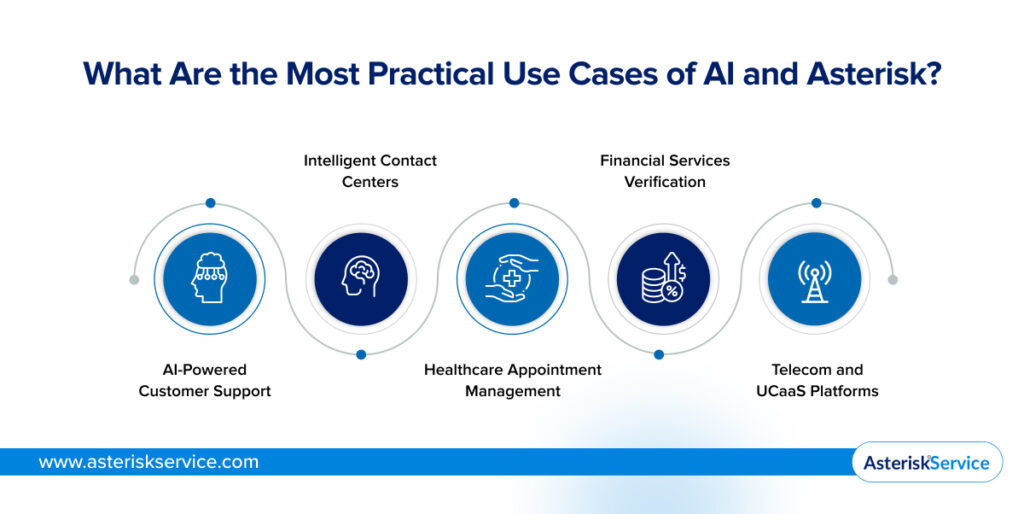
1. AI-Powered Customer Support
Many customer inquiries are repetitive and predictable.
An Asterisk AI agent can handle routine requests such as account inquiries, order updates, and appointment confirmations without human intervention.
When a situation requires personal attention, the call can be seamlessly escalated to a live agent.
2. Intelligent Contact Centers
AI and contact center solutions move beyond traditional call handling.
Key capabilities include:
- Smart call routing
- Real-time agent assistance
- Live coaching and guidance
This improves customer experiences while helping agents resolve issues more effectively.
3. Healthcare Appointment Management
Healthcare providers can use AI with Asterisk to automate patient communication workflows.
Common applications include:
- Appointment scheduling
- Follow-up reminders
- Patient routing
This reduces administrative workloads and improves patient engagement.
4. Financial Services Verification
Security and customer experience are equally important in financial services.
Asterisk AI solutions can support:
- Voice authentication
- Fraud detection
- Secure self-service interactions
These capabilities help streamline verification while strengthening security measures.
5. Telecom and UCaaS Platforms
Telecom providers, UCaaS vendors, and communication service providers are increasingly embedding AI into their offerings.
AI-powered enhancements include:
- Voice AI experiences
- Conversational analytics
- Automated customer support
This allows providers to deliver more intelligent communication services while creating additional value for customers.
Across industries, AI and Asterisk are helping businesses transform voice interactions from simple conversations into intelligent, data-driven experiences.
The next step is connecting these components.
What Does an AI-Enabled Asterisk Architecture Look Like?
An AI-enabled Asterisk architecture combines telephony, AI, business data, and automation layers to create intelligent voice experiences.
Each layer plays a specific role in helping an Asterisk AI agent understand conversations, make decisions, and execute actions in real time.
1. Communication Layer
The communication layer manages voice traffic and call control.
Its core components include:
- Asterisk PBX
- SIP infrastructure
This layer handles call initiation, routing, media processing, and connectivity between users and applications.
2. AI Layer
The AI layer adds intelligence to voice interactions.
Key technologies include:
- Speech recognition
- Large Language Models (LLMs)
- Natural Language Understanding (NLU) engines
Together, these components help AI understand conversations, identify intent, and generate appropriate responses.
3. Data Layer
The data layer provides the information needed for personalized interactions.
Common components include:
- CRM platforms
- Databases
- Analytics systems
This allows Asterisk AI integration to access customer records, interaction history, and operational insights during a call.
4. Automation Layer
The automation layer connects conversations with business processes.
It typically includes:
- Workflow engines
- APIs
- Business applications
This enables AI systems to trigger actions such as creating tickets, updating records, scheduling appointments, or sending notifications automatically.
These outcomes depend on how the system is built.
What Challenges Should Businesses Consider When Implementing Asterisk AI Integration?
Asterisk AI integration offers significant benefits, but successful deployment requires careful planning around performance, security, scalability, and operational costs.
While Asterisk AI can transform call handling, combining it with proactive Asterisk troubleshooting helps ensure reliable and scalable deployments.
Understanding these challenges early helps businesses build reliable and future-ready communication systems.
1. Latency and Real-Time Performance
Voice conversations happen in real time.
Even small delays can affect the customer experience.
AI services such as speech recognition, LLMs, and sentiment analysis must process requests quickly to maintain natural interactions.
Optimizing infrastructure and API response times is critical for minimizing latency.
2. Data Privacy and Compliance
Voice interactions often contain sensitive information.
Organizations must ensure that customer data is collected, processed, and stored securely.
Depending on the industry, compliance requirements may include:
- GDPR
- HIPAA
- PCI-DSS
Strong security controls and governance policies are essential for protecting customer information.
3. Scalability Requirements
As call volumes increase, the underlying infrastructure must scale accordingly.
Businesses need to consider:
- Concurrent call handling
- AI processing workloads
- Storage requirements
- Network performance
A scalable architecture helps maintain consistent service quality during peak traffic periods.
4. Cost Management
AI-powered communications involve more than telephony infrastructure.
Costs may include:
- AI model usage
- Speech processing services
- Cloud infrastructure
- Data storage
Balancing performance and operational costs is important for long-term sustainability.
The next step is ensuring these systems are implemented effectively.
What Are the Best Practices for Building AI with Asterisk?
Successful AI with Asterisk deployments focus on solving real business problems before expanding into more advanced capabilities.
A phased approach often delivers better results than attempting to automate everything at once.
1. Start with High-Impact Use Cases
Begin with applications that deliver immediate value.
Common examples include:
- Intelligent call routing
- Voice transcription
- Call summarization
These use cases typically provide measurable improvements with minimal disruption.
2. Keep Human Escalation Paths Available
AI should enhance customer service, not create barriers.
Customers should always have a clear path to a live agent when needed.
This helps maintain trust while improving service quality.
3. Optimize AI and Telephony Together
AI performance depends heavily on the underlying communication infrastructure.
Asterisk, SIP infrastructure, AI services, and business applications should be designed as a unified system.
This improves reliability and reduces operational complexity.
4. Continuously Improve AI Models
Customer expectations and business requirements evolve over time.
Regularly reviewing conversations and performance metrics helps improve routing accuracy, automation outcomes, and customer experiences.
Small improvements can create significant long-term gains.
The technology is evolving quickly, and so are the possibilities.
What Is the Future of AI and Asterisk?
The future of AI and Asterisk lies in communication systems that can understand context, adapt in real time, and respond intelligently.
As these capabilities evolve, Asterisk development for business communication will enable businesses to create more efficient and personalized customer experiences.
1. Generative AI Voice Agents
Future Asterisk AI agents will handle increasingly complex conversations.
They will be able to maintain context, access multiple systems, and resolve a wider range of customer requests without human assistance.
2. Real-Time Agent Assistance
AI will provide live recommendations during conversations.
Agents will receive guidance, suggested responses, and relevant customer information while calls are in progress.
3. Predictive Customer Support
AI systems will anticipate customer needs before issues escalate. This will enable proactive support and more efficient service delivery.
4. Autonomous Contact Centers
Routine interactions will become increasingly automated. Human agents will focus on high-value conversations that require empathy, judgment, or specialized expertise.
5.Hyper-Personalized Customer Experiences
Future communication systems will combine customer history, behavioral insights, and real-time context to create highly personalized interactions.
Every caller experience will become more relevant and efficient.
The Bottom Line?
The role of Asterisk has expanded far beyond traditional call routing.
Through Asterisk AI integration, businesses can combine intelligent routing, conversational AI, voice analysis, and automation within a single communication ecosystem.
From building an Asterisk AI voice agent to enabling real-time conversation intelligence, AI is transforming Asterisk telephony systems into platforms that can understand, analyze, and respond to customer interactions more effectively.
Organizations that adopt AI with Asterisk today are not simply improving call handling. With the right implementation partner, such as Asterisk Service, they can build intelligent communication experiences that scale with customer expectations and business growth.
FAQs
What is Asterisk AI integration?
Asterisk AI integration combines artificial intelligence technologies with the Asterisk telephony system to enable intelligent call routing, voice automation, conversational AI, and real-time voice analysis. It allows businesses to create smarter communication workflows that can understand and respond to customer interactions more effectively.
How does AI improve call routing in Asterisk?
AI improves call routing by analyzing caller intent, conversation context, customer history, and real-time sentiment before routing a call. Unlike traditional rule-based systems, AI-powered routing helps reduce transfers, improve first-call resolution, and deliver more personalized customer experiences.
What is an Asterisk AI agent?
An Asterisk AI agent is a virtual voice assistant integrated with Asterisk that can answer calls, understand natural language, access business systems, perform tasks, and escalate conversations when needed. It helps automate routine interactions while maintaining a seamless customer experience.
What is the difference between a traditional IVR and an Asterisk AI voice agent?
A traditional IVR relies on predefined menus and keypad inputs, while an Asterisk AI voice agent understands natural speech and caller intent. This allows customers to speak naturally instead of navigating multiple menu options, resulting in faster and more intuitive interactions.
Can AI be integrated into an existing Asterisk telephony system?
Yes. AI can be integrated into existing Asterisk deployments using technologies such as AGI, FastAGI, ARI, REST APIs, WebSockets, and SIP integrations. This enables organizations to add AI capabilities without replacing their current telephony infrastructure.