


Table of Contents
ToggleKey Highlights
The release of Asterisk 23.4.0 and its immediate security patch, version 23.4.1, marks a definitive shift toward hardening enterprise signaling paths and improving state recovery. This blog covers the low-level architecture changes across PJSIP task distribution, strict AsterRest Interface (ARI) access permissions, and structural multi-tenant storage configurations. We list fully removed modules, and explore the configuration parameters needed to run zero-loss telecom networks under high concurrency.
If you manage high-volume communication architectures, reviewing a major release note is rarely about looking for shiny new features. Instead, your core engineering focus is identifying performance enhancements, tracking security vulnerabilities, and ensuring your current configuration infrastructure will not break during an upgrade cycle.
The launch of the Asterisk 23.4.0 release series moves directly into this territory. This lifecycle transition moves past standard maintenance iterations to address structural bottlenecks in multi-tenant scaling, PJSIP state coordination, and security permission bypass vectors within the Asterisk REST Interface (ARI).
If you are looking for well-explained Asterisk 23.4.0 documentation, this technical analysis breaks down what has changed under the hood, why these developments impact your production cluster, and how to calibrate your systems safely.
What is New in Asterisk 23.4.0 for Multi-Tenant Architectures?
The Asterisk 23 framework brings optimized multi-tenant resource management designed to help clusters handle dense provisioning environments smoothly. The primary performance layer updated in this architecture centers on Sorcery (the underlying data abstraction engine that bridges core Asterisk modules to your configuration backends).
In high-concurrency environments that use multiple writable backends (such as a localized AstDB cache paired with a centralized Realtime SQL server), temporary network blips or database timeouts frequently cause data race conditions. If a database query fails right as a tenant endpoint attempts a registration refresh, a split-brain state occurs.
To solve this issue, the Asterisk 23.4.0 release notes introduce an explicit recovery flag within sorcery.conf: update_or_create_on_update_miss = yes.
Enabling this parameter instructs the engine to automatically recreate missing runtime objects immediately after temporary backend recoveries. This helps keep your multi-tenant environments synchronous and insulated from transient database dropouts.
[Writable Realtime DB Backend ] <--- (Network Failure / Timeout)
                |
                |
    [ Sorcery Cache Miss]
                +---> (If update_or_create_on_update_miss = yes)
                |
                |
[ Recreate State Object in AstDB] ---> [ Keep Tenant Line Active ] How Do PJSIP Task Pools Improve High-Concurrency Signaling?
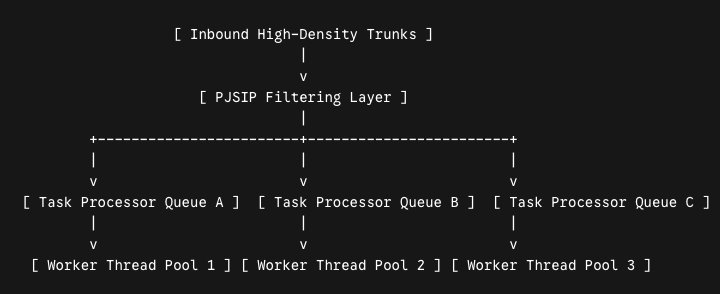
When evaluating what’s new in Asterisk 23.4.0, the transition of PJSIP’s underlying signaling mechanics is a critical baseline upgrade. In older architectures, simultaneous SIP requests over high-density trunks frequently encountered blocking conditions inside traditional thread pools. Under peak concurrent loads, worker threads would lock up while waiting for state validations, introducing signaling lag.
The modern PJSIP architecture avoids this block by deploying localized, thread-isolated task pools. Instead of forcing threads to pause dynamically during an active call leg, inbound SIP messages are compiled as lightweight tasks and distributed instantly to dedicated queues. This architecture keeps your media pipelines completely isolated from signaling processing friction.
Beyond these low-level queue changes, the 23.4.x generation adds precise endpoint control variables for multi-tenant and WebRTC routing paths:
- WebSocket Parameter Injection (chan_websocket): Using option v inside the Dial application, developers can now inject custom, dynamic URI parameters into outgoing WebSockets. This allows you to pass tracking IDs and tenant tokens seamlessly to external signaling layers.
- Auto-Stopping Tone Detection (res_tonedetect): The new option e commands the system to terminate tone monitoring immediately once a specified number of DTMF or frequency matches are achieved. This cuts down on unnecessary CPU cycles and prevents dialplan race conditions.
Understanding the New ARI Security Constraints and REST Controls
For platform builders running custom abstraction software on top of Asterisk, the REST Interface adjustments detailed in the Asterisk 23.4.0 release require an immediate audit of your application code. This patch strictly addresses a security privilege-escalation vector in which API calls could bypass internal safeguards.
ARI applications must now explicitly respect the live_dangerously configuration parameter defined within your core asterisk.conf file. If this security flag is set to no, any external ARI applications that attempt to invoke dangerous dialplan execution blocks (including commands such as SHELL(), CURL(), DB(), or FILE()) will be automatically denied.
If your custom software relies on ARI to inject shell macros or pull remote web data, your upgrade deployment plan must incorporate explicit permission adjustments. Does your orchestration layer look like it requires deep architectural refactoring to stay compliant with these security changes?
Which Components Are Removed in Asterisk 23.4.x?
A critical step in evaluating an Asterisk platform migration involves identifying deprecated and removed modules. The 23.4.x environment fully removes several legacy dependencies to reduce technical debt and minimize your overall attack surface.
💡 Expert Tip
Use the newly optimized /channels/{channelId}/progress REST endpoint to signal early media states explicitly before completing a full channel answer state.
By executing early media validations cleanly inside your custom ARI loops, you can stream network comfort indicators or play verification announcements without forcing a billing answer leg. This will help shield your underlying carrier trunks from early connection fees.
Also read our Asterisk Troubleshooting Guide.
Key Asterisk 24.0.x Configuration Variables to Verify in Your Upgrade Routine
Before compiling your software from source or updating your repository packages, your technical operations team should track these changes against your primary Asterisk 23.4.0 documentation templates:
1. Variables Processing Index Update
Config settings retrieved by name now return the most recently matching override value rather than the base configuration template. This mirrors a -1 index lookup to the AST_CONFIG function. If your deployment scripts rely on template inheritance, double-check that your overriding values do not inadvertently conflict with baseline properties.
2. High-Volume Security Sanitation
The release incorporates strict security validation patches designed to block unauthenticated memory overflow vectors. Ensure your system boundaries are clean across all edge nodes:
- LDAP Filter Escaping (res_config_ldap): Values are fully escaped per RFC 4515 to block injection queries via unauthenticated SIP Usernames.
- CEL Output Validation (cel_pgsql / cel_tds): The eventtype field now includes strict character escaping rules to prevent direct SQL injections through custom user events.
Upgrading to the modern Asterisk 23.4.x series ensures your network layer retains high performance, secure communication paths, and structural predictability under carrier-scale concurrent loads.
If your engineering team is hitting a wall with Sorcery synchronization errors, custom ARI tool modifications, or PJSIP thread locks, you don’t have to troubleshoot your infrastructure alone. We specialize in designing and optimizing high-density, multi-tenant telecom clusters built for absolute long-term stability.
Reach out to optimize your open-source Asterisk cluster infrastructure with experts!
FAQs
What is new in Asterisk 23.4.0 compared to older versions?
What’s new in Asterisk version 23.4.0 and 23.4.1 centers on critical multi-tenant data synchronization flags, high-concurrency PJSIP task pool distribution, restrictive ARI security constraints, and complete removal of obsolete channel drivers.
How do PJSIP task pools prevent thread locking in Asterisk 23?
PJSIP task pools prevent thread locking by compiling incoming SIP signaling requests into lightweight tasks and assigning them to isolated task queues rather than forcing standard threads to block during heavy concurrent traffic.
Why did my ARI application stop working in Asterisk 23.4.x?
Your ARI application stopped working because the latest Asterisk 23.4.0 release enforces strict compliance with the live_dangerously security parameter, automatically blocking unauthorized API applications from execution.
Is users.conf still supported in the latest Asterisk release?
No, the legacy users.conf configuration file is completely unsupported. Modern Asterisk 23.4.0 documentation dictates that all endpoints and channel parameters must be declared inside protocol-specific configuration files like pjsip.conf.
How does the update_or_create_on_update_miss parameter fix multi-tenant clusters?
This configuration parameter fixes multi-tenant environments by automatically recreating missing runtime data components in your local database cache the exact moment your primary Realtime SQL database engine recovers from a temporary network drop.