


Table of Contents
ToggleKey Highlights
Securing an Asterisk media core against toll fraud requires shifting from static single-tenant checklists to automated, platform-scale behavioral detection. This blog will help you understand the (step-by-step) mechanics of SIP exploitation, a three-tier defense matrix (SBC, Dialplan, Carrier), and the exact 10-minute incident response workflow when a fraud event triggers.
When an Asterisk system falls victim to toll fraud, the damage isn’t measured in minor performance glitches or temporary server downtime. It is calculated in tens of thousands of dollars billed to your carrier account in a matter of hours.
Most online Asterisk advice focuses on single-tenant SMB setups. They tell you to set strong PJSIP passwords, enable Fail2Ban, block international destinations, and check your CDRs every morning.
While essential, these baseline measures fail when operating an ITSP, a multi-tenant cloud PBX, or a high-concurrency contact center. Automated botnets do not sleep, and waiting for a human administrator to review yesterday’s CSV logs means discovering the breach long after the fraudulent traffic has cleared.
To protect high-concurrency telephony platforms, security teams must:
- Understand the exact technical execution of modern SIP exploitation.
- Deploy automated behavioral anomaly scoring.
- Enforce dynamic traffic policy controls at the network edge.
How Do Attackers Breach an Asterisk PBX System? (Step-by-Step)
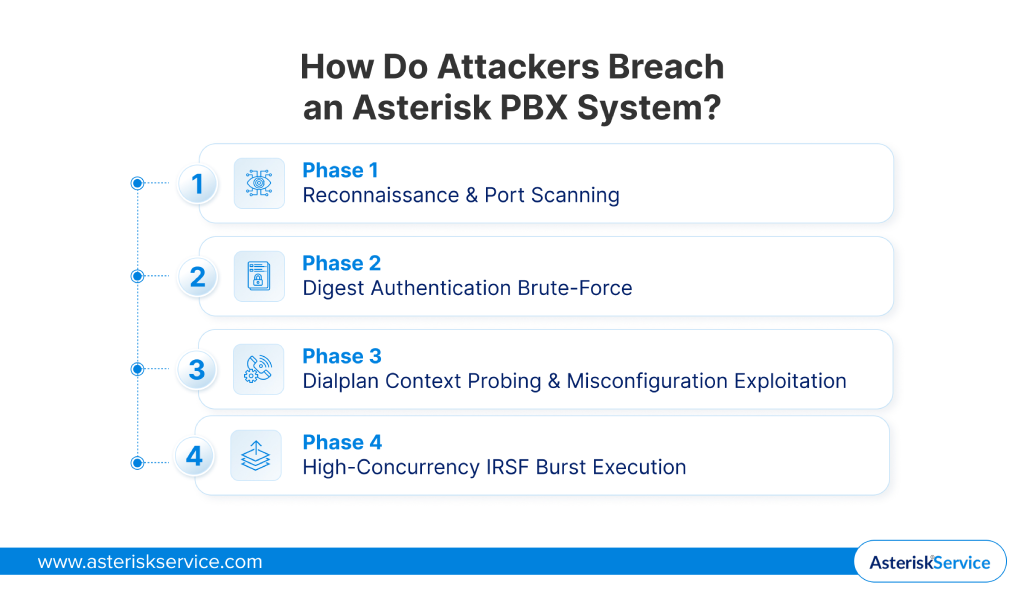
Attackers breach an Asterisk PBX by:
- Scanning open ports.
- Brute-forcing digest credentials using distributed botnets.
- Probing unauthenticated dialplan contexts.
- Immediately launching high-concurrency calls to expensive premium-rate international destinations.
Fraudulent operators do not manually hack PBX boxes. They utilize distributed, automated scanning botnets (using specialized toolkits like Sipvicious, Sipcli, or Friendly-Scanner) to discover and exploit vulnerable SIP endpoints at scale.
Phase 1: Reconnaissance & Port Scanning
Botnets scan public IPv4/IPv6 blocks, probing standard SIP signaling ports (UDP/TCP 5060, TLS 5061). They inspect User-Agent headers and SIP responses (200 OK, 401 Unauthorized, 403 Forbidden) to map out active Asterisk installations, identifying underlying software versions and endpoint names.
Phase 2: Digest Authentication Brute-Force
Once a target endpoint is identified, the botnet executes a rapid dictionary attack against PJSIP endpoints. Attackers cycle through common numeric extension identifiers (101, 1001, 8000) paired with weak SIP secrets. Distributed botnets spread these authentication requests across thousands of rotating residential proxy IPs to deliberately bypass standard, static Fail2Ban maxretry thresholds.
Phase 3: Dialplan Context Probing & Misconfiguration Exploitation
If extension registration fails, attackers attempt unauthenticated INVITE requests directly against the Asterisk server. They exploit three critical misconfigurations:
- Insecure Context Mapping: Assigning inbound trunk contexts to execution contexts that contain outbound international dialing rules.
- Allowing Anonymous Calls: Leaving allow_unauthenticated_registrations=yes or failing to set allow_anonymous=no in pjsip.conf.
- Exposed Feature Rules: Exploiting misconfigured Direct Inward System Access (DISA), unauthenticated voicemail access menus, or vulnerable IVR transfers that allow external callers to generate a secondary outbound dial-tone.
Phase 4: High-Concurrency IRSF Burst Execution
Once outbound dialing access is achieved, the botnet immediately floods the system. Using automated scripts, the attacker forks 50 to 200+ concurrent SIP channels simultaneously, routing traffic to high-cost International Revenue Share Fraud (IRSF) destinations. This maximum-concurrency burst usually occurs during weekend hours or public holidays to maximize financial yield before administrative intervention.
What Are the Earliest Signals of Asterisk Toll Fraud in Asterisk Logs and CDRs?
The earliest signals of Asterisk fraud include rapid bursts of 401/403 authentication failures in AMI logs, spikes in short call duration ratios, and sudden jumps in average call length on international routes.
Relying on manual daily CDR reviews is insufficient for modern SIP fraud detection. Automated monitoring software must continuously parse Asterisk Security Events (AMI/ARI) and Real-Time CDR records to flag fraud in its earliest stages.
1. Real-Time Asterisk Security Event Protocol (AMI/Log Signals)
Modern Asterisk releases emit structured SecurityEvent JSON logs. Your monitoring stack (e.g., Logstash, Vector, or custom AMI daemons) should trigger immediate alerts on the following log patterns:
- InvalidAccountID / FailedACL Spikes: Multiple auth failures originating from single or distributed IP blocks within a 10-second window.
- ChallengeResponseFailed Patterns: Repeated failed digest handshakes indicating automated credential brute-forcing.
- InvalidPassword on Existing Extensions: A sudden burst of wrong passwords on known internal extension IDs indicates an active endpoint breach attempt.
2. CDR Anomaly Detection & Statistical Signals
Automated engines must monitor active Call Detail Records (CDRs) for statistical anomalies:
- Short Call Duration (SCD) Ratio Spikes: A sudden rise where >70% of outbound calls drop within 0 to 3 seconds indicates active dialplan probing or Wangiri dialing loops.
- Abnormal Average Length of Call (ALOC) Elevation: A sudden jump in ALOC on international routes (e.g., multiple channels staying connected for exactly 59:59 minutes) indicates active IRSF looping scripts.
- Zero-Duration Concurrent Answer Spikes: Dozens of calls answering within the exact same millisecond window indicate automated bot orchestration.
Which Fraud Types Impact Asterisk Platforms Most: IRSF, Wangiri, Call Selling, or CLI Spoofing?
International Revenue Share Fraud (IRSF) causes the most severe financial impact on Asterisk platforms, followed by Wangiri call-back loops, unauthorized call selling, and CLI spoofing used to bypass origin-based carrier billing filters.
Not all SIP abuse operates under the same financial or operational mechanics. According to the Communications Fraud Control Association (CFCA) Fraud Loss Survey Report, global telecommunications fraud losses climbed to $41.82 billion, with International Revenue Share Fraud (IRSF) remaining one of the primary drivers of unrecovered financial loss.
What Is International Revenue Share Fraud (IRSF)?
Attackers partner with rogue premium-rate number providers or compromised regional carriers in high-cost jurisdictions (e.g., specific destination ranges in small island nations or developing telecommunications markets). The attacker receives a negotiated payout (e.g., $0.10 to $0.50 per minute) for every minute of traffic delivered to those test numbers.
- Impact on Asterisk platform: High concurrency, long call durations (often looping audio files to keep channels open), and catastrophic financial loss within short timeframes.
What Is Wangiri (“One Ring and Cut”)?
An automated dialer generates thousands of short-duration, single-ring calls to public mobile subscriber numbers, spoofing an IRSF or premium-rate return number as the CallerID. Expecting an urgent missed call, unsuspecting consumers dial the number back, generating expensive outbound traffic through the carrier network.
- Impact on Asterisk platform: High call-per-second (CPS) rate spikes, high Answer-Seizure Ratio (ASR) drop-offs, and sudden outbound channel exhaustion.
What Is Call Selling & Traffic Wholesaling?
Once attackers acquire valid SIP registration credentials on your Asterisk core, they resell cheap international calling routes on dark-web wholesale portals. Unaware retail users route standard non-premium international traffic through your compromised PBX.
- Impact on Asterisk platform: Low-profile, steady call volume that closely mimics legitimate business usage, making it significantly harder to detect via simple concurrency threshold alerts alone.
What Is CLI Spoofing & Caller ID Impersonation?
Attackers manipulate the outbound P-Asserted-Identity (PAI), Remote-Party-ID (RPID), or From headers on outbound SIP INVITEs to pass arbitrary CLI strings. This is used to bypass origin-based call filtering, execute Vishing (voice phishing) attacks, or exploit weak CLI-authenticated IVR systems.
- Impact on Asterisk platform: Downstream carrier penalties, STIR/SHAKEN attestation demotions (from A-level to C-level), and severe legal or regulatory compliance exposure.
💡 Our Experts Suggest
Do not wait for a call to answer (200 OK) to evaluate fraud rules. Automated attack bots generate hundreds of 503 Service Unavailable, 404 Not Found, or 408 Request Timeout responses per minute as they probe non-existent destination ranges across your dialplan.
Configure your edge SBC or monitoring daemon to track the ratio of unanswered INVITE attempts relative to total outbound attempts. If an endpoint's failure ratio exceeds 60% over a 30-second window, automatically isolate the endpoint before it hits a valid outbound trunk route.
What Belongs at the SBC Layer vs. the Dialplan Layer vs. the Carrier Layer?
Asterisk security best practices suggest assigning:
- Rate-limiting and topology hiding to the SBC layer
- Authentication and context rules to the Asterisk dialplan layer
- Financial daily caps to the carrier layer
Effective protection requires a layered security model. Overloading Asterisk with raw packet filtering degrades media-switching performance and violates Asterisk security best practices. Distribute your defense logic across three distinct architectural boundaries:
| Security Layer | Primary Responsibilities | Specific Enforcement Mechanisms |
|---|---|---|
| Tier 1: Edge SBC (Kamailio / OpenSIPS) | Topology hiding, DDoS absorption, UDP rate limiting, scanner UA blocking. | Drops SIPvicious User-Agents, enforces IP velocity rate limits in Redis, strips internal SIP headers. |
| Tier 2: Asterisk Core (PJSIP / Dialplan) | Channel concurrency caps, context isolation, extension auth, ACL enforcement. | Sets max_contacts, restricts contexts to from-carrier, caps concurrent outbound channels via GROUP(). |
| Tier 3: Upstream Carrier | Daily financial spend caps, global high-risk country blocks, IP-ACL trunks. | Auto-disables international routes upon reaching $200 daily spend; restricts trunk access to static carrier IPs. |
Implementing Asterisk Dialplan Concurrency Guards
Enforce strict security guardrails within Asterisk itself using dialplan group counts:
; Dialplan Concurrency Cap Example
exten => _X.,1,NoOp(Enforcing Per-Extension Concurrency Cap)
 same => n,Set(GROUP()=USER_${CALLERID(num)})
 same => n,GotoIf($[${GROUP_COUNT(USER_${CALLERID(num)})} > 5]?block_overload)
 same => n,Dial(PJSIP/${EXTEN}@outbound-trunk)
 same => n,Hangup()
 same => n(block_overload),NoOp(Extension ${CALLERID(num)} Exceeded Channel Limit!)
 same => n,Hangup(17) ; User Busy
 If your engineering team is experiencing high-volume SIP scanning or struggling to configure SBC edge rules, you can consult with our Asterisk security engineers to deploy automated rate-limiting proxies!
How to Protect a Multi-Tenant Asterisk Platform Where Tenants Have Different Call Patterns?
Protecting a multi-tenant Asterisk platform requires dynamic per-tenant baselining that tracks historical hourly concurrency, establishes rolling average velocity thresholds, and scores destination risk dynamically per tenant partition.
In a multi-tenant ITSP or Hosted PBX architecture, rigid global rules fail. A call center tenant legitimately running 100 concurrent channels will trigger a global threshold designed for a 5-seat law firm tenant. Protecting multi-tenant environments requires shifting to dynamic per-tenant baselining:
[ Live Call Ingress ]
        |
        v
[ Calculate Tenant Risk Score ]
  - Deviation from Historical Hourly Velocity (+30 pts)
  - Destination Country Risk Profile (High-Risk IRSF: +50 pts)
  - Off-Hours / Weekend Dialing Pattern (+20 pts)
        |
        v
[ Score Evaluation ]
  - Score < 50   --> Allow Call Leg
  - Score 50-79  --> Require PIN / Step-Up Challenge
  - Score >= 80  --> Block Leg & Fire Security Alert
1. Dynamic Per-Tenant Velocity Baselining
Instead of static limits, calculate rolling 30-day statistical baselines for each tenant partition:
- Hourly Concurrency Moving Average (Cavg): Track peak concurrent channels per hour of the day. Set dynamic soft caps at Cavg+(3×σ) (where σ is standard deviation).
- Hourly Destination Entropy: Track the historical ratio of domestic vs. international destination countries for each tenant. If a tenant that historically dials 99% domestic numbers suddenly exhibits a 40% shift toward international destinations, flag the session immediately.
2. Destination Risk Scoring Matrix
Assign dynamic risk weightings to outbound call attempts based on destination attributes:
| Destination Category | Target Risk Score | Required Enforcement Action |
|---|---|---|
| Domestic Fixed / Mobile | Low (0 – 10) | Pass directly to outbound trunk. |
| Standard International (Tier 1) | Medium (15 – 35) | Verify tenant international dialing feature flag. |
| High-Risk IRSF Range | High (50 – 75) | Enforce secondary auth PIN or trigger admin SMS alert. |
| Known Unallocated / High-Fraud Range | Critical (80 – 100) | Block call instantly at SBC edge; issue temporary tenant suspension. |
How to Stop AI-Powered Voice Fraud Bots in Real Time?
You can stop AI-powered fraud in Asterisk platforms with AI-driven anomaly detection. It stops voice fraud bots by:
- Training machine learning models on real-time SIP signaling features.
- Detecting artificial call patterns.
- Executing automated API blocks before call charges accrue.
As fraudsters increasingly adopt generative AI tools to automate voice fraud campaigns, traditional static firewall rules are no longer sufficient. Machine learning models running alongside Asterisk inspect live signaling streams to block sophisticated AI botnets.
Here are some of the key capabilities of Asterisk AI fraud detection Engines:
- Signaling Pattern Clustering: Machine learning algorithms (such as Isolation Forests) analyze microsecond variations in SIP INVITE timing, RTP packet jitter, and header structure to identify automated bot orchestrations.
- Predictive Destination Risk Scoring: AI engines evaluate destination phone numbers against global cross-carrier threat intelligence databases, predicting whether an unassigned international range is participating in an active IRSF pumping scheme.
- Automated Mitigation: When the AI model detects anomalous behavior exceeding a 0.85 probability threshold, it communicates directly with your edge Session Border Controller over REST APIs, blocking the fraudulent call leg in under 5 milliseconds.
Also Learn How to Prepare Your Asterisk Deployment for AI and Voice Automation.
The First 10 Minutes of Asterisk Incident Response After a Fraud Alert Fires
During the first 10 minutes of a fraud incident on an Asterisk platform, engineers must immediately sever active channels, block the attacker’s source IP, disable international outbound contexts, and capture forensic log evidence.
When an automated security alert fires or your carrier notifies you of an active Asterisk toll fraud burst, every second counts. Execute this structured 10-minute triage playbook to contain the breach instantly:
Minute 0 – 2: Stop the Financial Bleeding Immediately
Do not spend time analyzing logs while fraudulent calls are active. Sever active channels instantly:
- Asterisk CLI Action: Force-hangup active calls on the compromised trunk or context:
asterisk -rx "channel request hangup all"
# Or target specific compromised PJSIP endpoints:
asterisk -rx "pjsip show channels"
asterisk -rx "channel request hangup <channel_id>"
- SBC Edge Action: Drop all active media sessions associated with the attacker’s source IP or tenant ID at the SBC firewall layer.
Minute 2 – 4: Isolate the Compromised Credentials & Source IP
Prevent the botnet from immediately reconnecting:
- Block the offending source IP address permanently across your firewall rules:
iptables -I INPUT -s <ATTACKER_IP> -j DROP
fail2ban-client set asterisk banip </ATTACKER_IP>
- Disable the compromised PJSIP endpoint in Asterisk:
asterisk -rx "pjsip set endpoint <ENDPOINT_NAME> status disable"
Minute 4 – 7: Truncate Outbound Trunk Routes
If the breach origin remains uncertain, temporarily disable international outbound route contexts at the dialplan layer while keeping domestic emergency lines functional:
; Temporarily disable international outbound context in extensions.conf
[outbound-international]
exten => _011X.,1,NoOp(TEMPORARILY DISABLED DUE TO SECURITY INCIDENT)
 same => n,Playtones(congestion)
 same => n,Hangup(34)
- Reload the dialplan immediately:
asterisk -rx "dialplan reload"
Minute 7 – 10: Preserve Forensic Evidence & Notify Carrier
- Preserve Log Files: Immediately copy active Asterisk logs, security events, and raw pcap captures to a secure analysis directory before log rotation overwrites the evidence:
cp /var/log/asterisk/messages /var/log/asterisk/forensics_$(date +%Y%m%d_%H%M%S).log
- Contact Wholesale Carrier: Notify your upstream carrier’s fraud ops department to confirm that the burst has ceased and request call fee mitigation for confirmed IRSF traffic.
- Force Password Rotations: Reset SIP secrets for all compromised endpoints using strong, cryptographically secure 24-character strings.
Protecting high-concurrency platforms against modern Asterisk toll fraud requires moving past basic static checklists. While strong passwords, local Fail2Ban rules, and restricted dialplans provide an essential foundation, scaling an ITSP or enterprise voice core demands automated, real-time behavioral observability.
By isolating your media core behind a custom SBC edge, implementing dynamic per-tenant baselining, and maintaining an automated incident response pipeline, you insulate your network against financial abuse (while preserving seamless service reliability for legitimate traffic).
If your Asterisk platform is experiencing recurring brute-force attacks, high international traffic risks, or requires an automated SIP fraud detection architecture, our senior telecom security teams can help.
Speak with our voice security architects today!
FAQs
How to protect a multi-tenant Asterisk platform where each tenant has different call patterns?
Multi-tenant Asterisk platform protection requires isolating tenant contexts at the dialplan layer and assigning per-tenant rate limits in an edge SBC (like Kamailio). By maintaining independent database profiles for each tenant’s historical dialing hours, allowed destination countries, and maximum channel capacities, you prevent one tenant’s breach from compromising the broader platform.
How do I set velocity and concurrency thresholds without blocking legitimate call spikes?
Avoid static concurrency caps that trigger false positives during business hours. Instead, calculate rolling 30-day statistical baselines (Cavg+3σ) per tenant. Pair these dynamic thresholds with destination risk scoring, so a sudden 50-call burst to domestic numbers is allowed, while a 10-call burst to high-risk IRSF ranges triggers an immediate authentication step-up or alert.
Which Asterisk configuration setting poses the highest immediate risk for Asterisk toll fraud?
The highest Asterisk toll fraud risk stems from placing untrusted ingress trunk traffic inside a dialplan context that includes outbound international dialing rules. Another critical misconfiguration is leaving allow_unauthenticated_registrations=yes or failing to disable anonymous SIP calls in pjsip.conf, allowing external attackers to bridge calls through your system without credentials.
What is the difference between static Fail2Ban filtering and real-time SIP anomaly detection?
Static Fail2Ban monitors log files for repeated failed authentication attempts from a single IP address and applies local firewall blocks. Real-time SIP anomaly detection analyzes broader behavioral data across distributed networks (such as sudden spikes in call velocity, abnormal Average Length of Call (ALOC), or unusual IRSF destination patterns), flagging fraud even when attacks are spread across rotating residential proxy botnets.
Can you run a low-latency STT/LLM/TTS AI voice pipeline on Asterisk without migrating?
Yes, you can run an AI voice pipeline on Asterisk by using AudioSocket to stream raw linear PCM audio over TCP to an external gateway. However, as concurrent call volume scales, Asterisk’s process-per-channel execution model and linked-list memory locks create CPU thread starvation, making it difficult to maintain sub-500ms latency under heavy concurrent loads.